Automated Branding for Consistent Marketing Success: The Practical Guide for Small Brands
Automated branding is not about making your marketing robotic. It is about turning your brand rules, product data, campaign ideas, and approval process into a repeatable system that keeps every post on-brand.

Brand consistency sounds simple until someone opens Canva at 11:47pm, chooses a font “just for this one post,” exports the wrong logo, writes a caption that sounds suspiciously like a motivational fridge magnet, and calls it marketing.
We have all seen it.
One post feels premium. The next one feels like it was made during a power outage. The launch email sounds polished. The Instagram caption sounds like a different company. The product page says one thing. The ad says another. The brand guide exists, technically, but it has the energy of a museum artifact: beautiful, expensive, and rarely touched.
That is where automated branding becomes useful.
Not because brands need more automation for the sake of automation.
Because modern marketing has too many moving pieces for consistency to depend on memory, mood, and whoever had the least chaotic Tuesday.
Automated branding for consistent marketing success means turning your brand identity into a system. Your colors, fonts, tone of voice, product details, visual style, campaign goals, and approval rules stop living in scattered documents and start guiding the actual content you publish.
The goal is not to make your brand colder.
The goal is to make your standard easier to protect.
Jump to the part you need.
A quick map for founders, marketers, and anyone trying to keep a brand from slowly becoming seven different brands.
Automated branding is how your brand stops changing outfits every Tuesday.
A practical visual guide to keeping your marketing consistent across posts, campaigns, products, and platforms — without turning your brand into a very efficient beige robot.
Brand drift happens one “quick post” at a time.
Check your last 10 posts.
What is automated branding?
Automated branding is the use of software, AI, templates, workflows, and approval systems to apply your brand identity consistently across marketing content.
That includes your:
- Logo usage
- Color palette
- Typography
- Tone of voice
- Product messaging
- Campaign style
- Social media content
- Email content
- Ad creative
- Landing pages
- Brand approvals
- Publishing workflow
In simple words: automated branding helps your marketing look and sound like the same brand everywhere.
A normal brand guide tells people what your brand should look like.
Automated branding helps your tools follow those rules while content is being created.
That distinction matters.
A PDF brand guide is passive. It waits for someone to open it.
An automated branding system is active. It sits inside the workflow and helps every asset stay aligned before it goes live.
Why automated branding matters now
Most small brands do not have a brand problem.
They have a production problem.
They know what they want the brand to feel like. They know the product should look polished. They know the caption should sound clear, not generic. They know the launch should feel intentional.
But there is too much content to make.
A product-based brand might need TikTok posts, Pinterest pins, Instagram captions, Facebook variations, product carousels, email announcements, launch graphics, seasonal campaigns, founder updates, and ads.
Then every piece needs to match the brand.
That is a lot of creative quality control for a small team.
This is why automation is becoming part of the marketing workflow. McKinsey reported that 78% of surveyed organizations were using AI in at least one business function, with marketing and sales among the most common areas. Another McKinsey report found that AI-related revenue benefits are most commonly reported in marketing and sales, strategy and corporate finance, and product or service development.
But there is a catch.
AI makes it easier to produce content.
It does not automatically make that content good.
That is why automated branding matters. The problem is no longer “Can we make more content?” The problem is “Can we make more content without slowly sanding off everything that makes the brand recognizable?”
The real problem: brand drift
Brand drift is what happens when your marketing becomes slightly less like you every time something gets made.
It usually starts quietly.
One freelancer uses an old logo.
One caption sounds too formal.
One product image uses a background that does not match your feed.
One email has a different CTA style.
One launch campaign uses three different tones because it was built in pieces.
None of these mistakes are catastrophic alone.
Together, they create a brand that feels inconsistent.
And inconsistency creates friction. Customers may not consciously say, “This brand has weak creative governance.” Normal people do not say things like that at brunch. But they do feel when something is off.
They hesitate.
They forget you.
They trust you a little less.
Consistent branding has been linked to revenue impact in brand consistency research, with Lucidpress reporting that consistent branding could increase revenue by up to 33%. The exact number will vary by business, but the direction makes sense: when people recognize you faster and trust you sooner, marketing works better.
Automated branding vs marketing automation
These two terms are related, but they are not the same.
Marketing automation usually focuses on distribution and customer journeys.
It helps you send emails, schedule posts, trigger workflows, segment audiences, and follow up with leads.
Automated branding focuses on consistency.
It helps ensure the content being distributed actually follows your brand identity.
Think of it this way:
Marketing automation answers:
“How do we send the right thing at the right time?”
Automated branding answers:
“Does the thing we are sending actually feel like us?”
You need both.
A perfectly scheduled off-brand post is still off-brand.
A beautiful brand guide that never reaches the publishing workflow is still just a document.
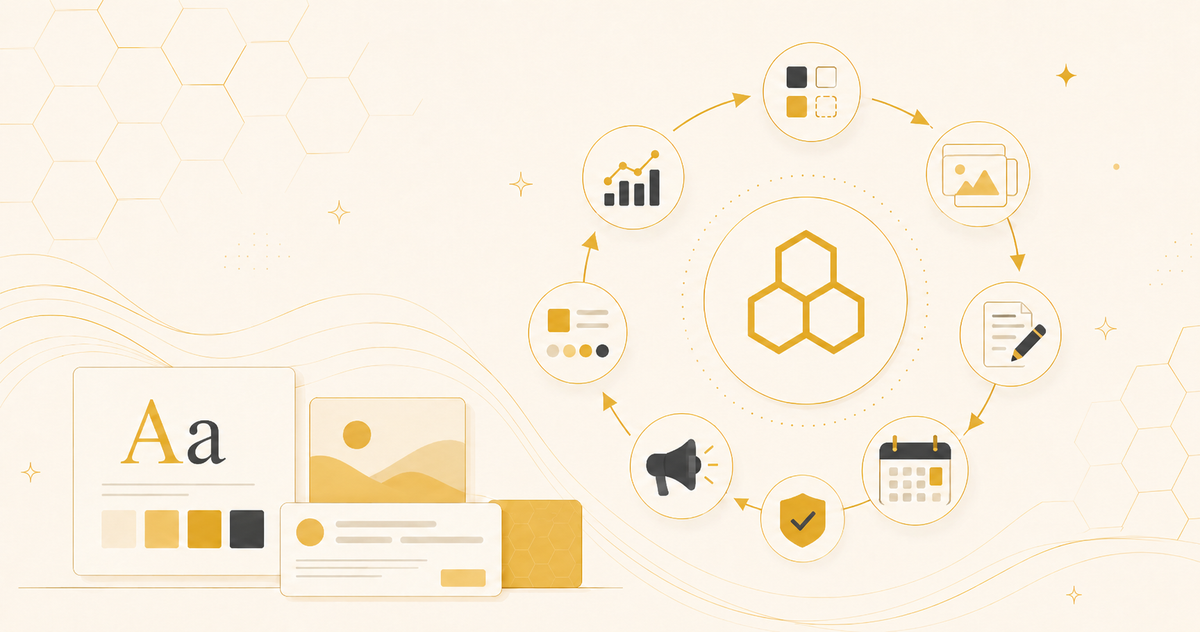
The best system connects the two: brand rules guide content creation, content moves through review, approved posts get scheduled, and the brand stays consistent across every channel.
The automated branding loop.
This is the actual system. Your brand rules guide the content, humans approve the work, and every campaign teaches the next one how to perform better.
Branding Loop A repeatable system for turning brand context into consistent published content.
Brand rules
Colors, fonts, tone, visual style, logo rules, and what your brand should never do.
Product context
Product names, features, benefits, images, and content-ready details for campaigns.
Campaign goal
Launch, promote, educate, announce, build trust, or create a repeatable content series.
AI draft creation
The system generates visuals, captions, carousels, and platform variations from that context.
Human approval
You review, edit, approve, reject, or regenerate before anything reaches the calendar.
Publish, learn, repeat
Approved posts go live, performance teaches the next cycle, and consistency compounds over time.
The four parts of a strong automated branding system
An automated branding system does not have to be complicated. It just needs the right structure.
Here are the four parts that matter most.
1. Brand rules that software can actually use
Most brand guidelines are written for humans.
That is not bad. Humans need context.
But automation needs specificity.
“Use warm colors” is hard to automate.
“Use #FFFCF3 as the dominant light background, #1A1917 for dark surfaces, and #FFC107 as the primary accent” is much more useful.
“Sound premium” is vague.
“Use direct sentences, avoid exaggerated claims, keep CTAs simple, and do not use hype language” is actionable.
GrowthGear’s guide makes this point clearly: automated branding works better when brand guidelines become machine-readable rules, with exact colors, font weights, logo rules, visual rules, and tone parameters.
For small brands, this does not mean creating a 90-page corporate brand manual.
It means turning your brand into usable inputs.
At minimum, define:
- Primary colors
- Secondary colors
- Fonts
- Logo rules
- Image style
- Caption tone
- CTA style
- Words you use
- Words you avoid
- Product positioning
- Audience description
- Examples of good content
- Examples of bad content
The more specific the input, the less cleanup you need later.
2. A central source of truth
Automated branding breaks when assets are scattered.
If your logo is in one folder, product photos are in another, brand colors are in someone’s notes app, and the latest campaign copy is buried in Slack, consistency becomes a scavenger hunt.
A brand system needs one place where the correct information lives.
That could be a digital asset management system, a brand portal, a shared content library, or a marketing platform with brand memory.
The point is simple: your team should not have to guess which file, color, logo, product description, or message is current.
This is especially important for ecommerce and product-based brands. Product details change. Offers change. Campaigns change. New images get added. Seasonal angles appear. If content is built from outdated information, the output may look fine but still be wrong.
Automated branding works best when the brand and product data are connected.
3. Content generation that starts from the brand, not a blank prompt
This is where many AI content tools fail.
They start with a blank box.
So the founder types something like:
“Write an Instagram caption for my skincare product in a premium tone.”
The result is usually polished.
It is also usually generic.
That is because the AI does not really know the brand. It knows the prompt.
A stronger automated branding workflow starts with stored brand context:
- What the brand sounds like
- What the product actually does
- What the campaign goal is
- What platform the content is for
- What visual style should be used
- What claims should be avoided
- What CTA fits the brand
This is the difference between prompt-based content and brand-aware content.
Prompt-based content asks the user to rebuild the brief every time.
Brand-aware content keeps the brief inside the system.
That is exactly where BeeWritten’s positioning fits. BeeWritten is built as a premium, brand-aware creative operations platform rather than a simple caption generator or one-click AI toy. It also includes brand guideline import, brand identity extraction, tone detection, product URL import, campaign generation, content scheduling, and human approval workflows.
That matters because automated branding is not just about making content faster.
It is about making the right content easier to repeat.
4. Human approval before publishing
Automation should speed up production.
It should not remove judgment.
This is especially important now that AI can produce a lot of content very quickly. McKinsey found that only 27% of respondents whose organizations use generative AI said employees review all AI-created content before use. For brands, that is risky.
A good automated branding system should keep humans in the loop.
The workflow should look like this:
- The system learns the brand.
- The system generates content.
- The founder or team reviews the drafts.
- Edits happen if needed.
- Only approved content gets scheduled or published.
That review step protects the brand.
It also protects the customer experience.
Automation can apply rules. Humans still understand context, timing, sensitivity, taste, and whether something simply feels right.
The best automated branding systems do not replace creative judgment.
They give creative judgment more room to breathe.
How automated branding creates consistent marketing success
Consistency is not just a design concern.
It affects the whole marketing workflow.
Here is how automated branding improves the parts of marketing that small brands usually struggle with.
It makes content creation faster
Without automation, every post starts from scratch.
You need to choose the product angle, write the caption, select the image, check the tone, format it for the platform, add hashtags, and schedule it.
With automated branding, much of that setup is already done.
The brand identity is stored.
The product information is available.
The campaign goal is clear.
The platform requirements are known.
The system can generate a strong first draft much faster than a human starting from zero.
The founder still reviews it.
But reviewing is faster than producing everything manually.
It keeps your brand voice consistent
A consistent brand voice does not mean every caption sounds identical.
It means every caption feels like it came from the same company.
That includes sentence rhythm, vocabulary, level of warmth, CTA style, humor, confidence, and how much explanation you give.
For example, a premium skincare brand, a playful stationery brand, and a technical SaaS product should not sound the same.
Automated branding helps prevent that by storing the voice as part of the content system.
The AI is not guessing the tone every time.
It is applying the tone you already defined.
It reduces creative rework
Most creative rework happens because the brief was unclear or incomplete.
The designer did not know the new colors.
The copywriter did not know the campaign angle.
The social media manager did not know the product positioning.
The founder had the full picture, but that picture lived in their head.
Automated branding reduces that gap.
When the system already knows the brand rules, product details, and campaign goal, the first draft gets closer.
Fewer “not quite right” moments.
Fewer late-night fixes.
Fewer assets that need to be rebuilt from scratch.
It makes small brands look more established
Big brands look consistent because they have systems.
They have brand teams, creative directors, approval processes, asset libraries, campaign calendars, and people whose entire job is making sure nothing weird ships.
Small brands usually do not.
Automated branding gives smaller teams a lighter version of that operating system.
Not the bureaucracy.
The consistency.
This is why the opportunity is especially strong for ecommerce, DTC, solo founders, and small agencies. They need premium output, but they cannot hire a full creative team for every product launch.
It helps every channel feel connected
Customers do not experience your brand one channel at a time.
They might see a TikTok, click a product page, save a Pinterest pin, read an email, check your Instagram, and then return three days later through an ad.
If each touchpoint feels different, the brand becomes harder to remember.
Automated branding helps connect those touchpoints.
The TikTok caption, Pinterest pin, Instagram carousel, product ad, and launch email can all come from the same brand identity and campaign direction.
That does not mean they should be copied and pasted everywhere.
It means they should feel related.
Same brand.
Different format.
A simple automated branding workflow for small brands
Here is the practical version.
You do not need to automate everything on day one.
Start with the parts that create the most inconsistency.
Step 1: Audit your brand drift
Look at your last 20 marketing assets.
Include social posts, emails, ads, product graphics, landing pages, and campaign visuals.
Ask:
- Do the colors match?
- Does the tone feel consistent?
- Are product benefits described the same way?
- Are CTAs similar?
- Are visuals recognizably from the same brand?
- Are some posts more polished than others?
- Would a new visitor understand what we sell?
- Would a returning customer recognize us quickly?
Mark every asset as:
- On-brand
- Almost on-brand
- Off-brand
You will usually see the pattern quickly.
Step 2: Turn your brand into rules
Write down the rules that would prevent the mistakes you found.
For example:
Instead of:
“We like clean visuals.”
Write:
“Use warm neutral backgrounds, generous negative space, product-first compositions, minimal props, and one accent color maximum.”
Instead of:
“We sound friendly but premium.”
Write:
“Use clear sentences, light warmth, no slang, no hype claims, no excessive punctuation, and CTAs that feel direct.”
Good automation starts with good rules.
Step 3: Create your content source of truth
Collect the information your marketing uses again and again:
- Product names
- Product descriptions
- Features
- Benefits
- Use cases
- Product images
- Brand colors
- Logos
- Fonts
- Campaign offers
- Audience pain points
- Approved captions
- Best-performing posts
- Brand voice examples
This becomes the base for automated content creation.
Step 4: Build repeatable campaign types
Most brands do not need infinite content types.
They need a few repeatable campaign workflows.
For example:
- Product launch campaign
- Seasonal promotion
- Educational content series
- Founder story series
- Social proof campaign
- Restock announcement
- New collection teaser
- Pinterest discovery campaign
- TikTok product awareness campaign
Once you know the campaign type, automation becomes much easier.
The system can generate content for a known goal instead of guessing what “make some posts” means.
Step 5: Generate drafts, not final decisions
This is the healthy way to use AI.
Let automation create the first version.
Then you review.
You approve what works, edit what is close, and regenerate what misses the mark.
This keeps the workflow fast without giving up control.
Step 6: Schedule from the same workflow
Content creation and scheduling should not feel like two separate jobs.
Once the content is approved, it should move into the calendar.
That is where marketing automation and automated branding come together.
The brand rules protect the asset.
The calendar protects consistency.
The approval process protects quality.
Step 7: Measure what improves
Track practical metrics.
Not vanity metrics only.
Useful automated branding metrics include:
- Time to create a campaign
- Number of revision rounds
- Number of posts approved without major edits
- Posting consistency
- Brand error rate
- Engagement by campaign type
- Click-through rate
- Conversion rate from social content
- Saved time per week
- Number of platforms kept active
The goal is not simply “more content.”
The goal is better marketing rhythm with fewer off-brand mistakes.
What should you automate first?
Start with the repetitive pieces.
Automate:
- Product information extraction
- Caption first drafts
- Hashtag suggestions
- Social post formatting
- Carousel structure
- Campaign content batches
- Scheduling reminders
- Platform variations
- Reusable templates
- Draft status tracking
Keep human:
- Brand positioning
- Final approval
- Sensitive claims
- Customer conversations
- Major campaign direction
- Pricing decisions
- Creative taste calls
- Crisis communication
A good rule:
Automate the repeated work.
Protect the meaningful decisions.
Common automated branding mistakes
Automated branding can go wrong when the system is built badly.
Here are the mistakes to avoid.
Mistake 1: Automating before defining the brand
If the brand is unclear, automation will not fix it.
It will simply repeat the confusion faster.
Before using automation, define the basics: audience, tone, visual style, product positioning, and what the brand should never do.
Mistake 2: Treating AI as a brand strategist
AI can help organize, generate, and apply.
But the core brand choices still need human judgment.
Your positioning, taste, customer understanding, and values should not be outsourced to a blank prompt.
Use AI to execute the brand.
Do not let it invent the brand every morning.
Mistake 3: Using too many disconnected tools
One tool for captions.
One for images.
One for scheduling.
One for product info.
One for approvals.
One for analytics.
This can work, but it often creates more coordination work than it removes.
The more tools you use, the more important your source of truth becomes.
Mistake 4: Skipping approval
Auto-publishing sounds efficient until something weird goes live.
Keep approval in the workflow.
Every serious brand needs a final check.
Mistake 5: Making everything look identical
Consistency is not sameness.
Your brand should feel recognizable, not repetitive.
Good automated branding creates variety inside clear boundaries.
Different hooks.
Different layouts.
Different campaign angles.
Same underlying brand.
Automated branding checklist
Use this before choosing a tool or building your workflow.
Your automated branding system should help you:
- Store brand colors, fonts, logos, and visual rules
- Define tone of voice clearly
- Import or organize product information
- Generate content from brand and product context
- Create platform-specific captions
- Generate visuals that match the brand style
- Build campaign content in batches
- Create carousel structures
- Keep humans in the approval loop
- Schedule approved posts
- Avoid auto-publishing unapproved drafts
- Track post status
- Support edits and regenerations
- Keep content consistent across platforms
- Save time without flattening the brand
If a tool only schedules posts, it is marketing automation.
If a tool only makes captions, it is content generation.
If a tool connects brand identity, product data, campaign planning, content creation, approval, and scheduling, you are closer to true automated branding.
Automated branding for ecommerce brands
Ecommerce brands benefit from automated branding because product content is repetitive but still needs taste.
Every product needs:
- Product visuals
- Descriptions
- Social posts
- Launch content
- Benefits
- Use cases
- Offers
- Seasonal angles
- Platform-specific variations
Doing that manually for every product is slow.
Doing it with generic AI is risky.
Automated branding gives ecommerce brands a better path: product-first content that still follows the brand.
A product URL can become the starting point.
The system reads the product name, images, features, benefits, and description. Then it creates content that fits the brand identity and campaign goal.
That is much stronger than asking AI to “make a post for a cute mug.”
The post becomes specific to the product.
And specific content is usually more persuasive.
The BeeWritten angle
BeeWritten is built around a simple belief:
Small brands should not need a full creative team to look like they have one.
The creative team has always been a privilege of scale. Bigger brands can afford designers, photographers, copywriters, social media managers, and brand directors. Smaller brands usually cannot.
Automated branding changes that.
BeeWritten learns your brand, imports product context, generates social content, and keeps approval in your hands before anything publishes.
The work gets faster.
The brand stays yours.
That is the version of automation worth building.
Not cold.
Not generic.
Not “AI content” for the sake of content.
A system that helps your brand show up consistently, even when your team is small, your campaign list is long, and Canva at midnight is starting to look a little too familiar.
Final thoughts
Automated branding for consistent marketing success is not about replacing the human part of marketing.
It is about protecting it.
Your taste matters.
Your product matters.
Your customer understanding matters.
Your brand voice matters.
Automation should not erase those things.
It should carry them into every post, campaign, caption, visual, and launch without forcing you to rebuild the same brief again and again.
The brands that win with AI will not be the ones publishing the most.
They will be the ones publishing consistently, recognizably, and with enough care that the automation becomes invisible.
That is the point.
Not more noise.
A better system.
FAQ
What is automated branding?
Automated branding is the use of software, AI, templates, brand rules, and workflows to keep marketing content consistent across channels. It helps brands apply their colors, fonts, logos, tone, product messaging, and campaign style without manually rebuilding every asset from scratch.
How does automated branding improve marketing success?
Automated branding improves marketing success by making content faster to produce, easier to approve, and more consistent across every platform. It reduces off-brand mistakes, improves recognition, and helps small teams maintain a professional brand presence.
Is automated branding the same as marketing automation?
No. Marketing automation usually focuses on sending, scheduling, and triggering campaigns. Automated branding focuses on making sure the content inside those campaigns follows your brand identity. The best workflow uses both.
Can small businesses use automated branding?
Yes. Small businesses often benefit the most because they usually do not have large creative teams. Automated branding helps them create consistent, polished marketing without hiring separate designers, copywriters, and social media managers for every campaign.
What can I automate in my branding workflow?
You can automate product data collection, content drafts, caption generation, hashtag suggestions, visual direction, carousel planning, platform formatting, scheduling, approval reminders, and campaign content batches. Final approval and strategic decisions should stay human.
Does automated branding make content generic?
Bad automation can. Good automated branding does the opposite. It uses your specific brand identity, product details, tone, and visual rules so content feels more recognizable, not less.
What is the best automated branding tool?
The best tool depends on your workflow. For product-based businesses, look for a platform that can learn your brand, use product data, generate visuals and captions, support approval, and schedule content. BeeWritten is built around that workflow.
How do I start with automated branding?
Start by auditing your current marketing content, identifying where your brand drifts, turning your brand rules into specific guidelines, centralizing your product and brand assets, and using a system that can generate content from that context.