Brand Strategy Automation: The Complete Guide for 2026
A complete guide to brand strategy automation: what it is, how it works, and how AI helps brands turn guidelines, product data, campaigns, and social content into one consistent workflow.


Brand strategy is easy to respect in theory.
In practice, it is usually a beautiful PDF named something like Brand_Guidelines_FINAL_final_v7.pdf, sitting in a folder nobody opens until a post goes live in the wrong font.
A founder writes the brand guide. A designer makes a few templates. A social media manager creates content when there is time. A freelancer interprets the tone a little differently. A product launch gets rushed. A seasonal campaign gets built in Canva at midnight with one eye open and a coffee that stopped helping two hours ago.
The brand still exists.
But the execution starts to drift.
The caption sounds close, but not quite right. The visuals look fine, but not unmistakably yours. The campaign gets published, but it feels like every post came from a slightly different version of the same company.
That drift is what brand strategy automation is built to solve.
Brand strategy automation is the use of AI, workflows, product data, brand guidelines, approval systems, and scheduling tools to turn your brand strategy into repeatable marketing execution.
Not just faster content.
Consistent content.
Not just more posts.
Posts that look, sound, and feel like they came from the same brand every time.
For small businesses, ecommerce brands, DTC founders, and lean marketing teams, this matters because the creative team has always been a privilege of scale. Bigger brands can afford photographers, designers, copywriters, social media managers, and brand directors. Smaller brands usually cannot.
Brand strategy automation changes the operating model. It lets a small team encode the brand once, then use that brand system across campaigns, products, platforms, and content formats without rebuilding the brief every time.
This guide explains what brand strategy automation is, how it works, what to automate, what to keep human, and how to build a brand automation workflow that actually protects your brand instead of flattening it.
Table of contents
- What is brand strategy automation?
- Brand automation vs brand strategy automation vs marketing automation
- Why brand strategy automation matters now
- What the data says about brand strategy automation
- The problem with generic automation
- What a brand strategy automation system needs to know
- How brand strategy automation works
- What to automate and what to keep human
- Brand strategy automation for small businesses
- Brand strategy automation for ecommerce and DTC brands
- The core components of a brand strategy automation platform
- Common brand strategy automation mistakes
- How to measure brand strategy automation ROI
- Best brand strategy automation software: what to look for
- BeeWritten: brand strategy automation for product-based businesses
- How BeeWritten turns brand strategy into content
- Example: brand strategy automation in a real product launch
- Brand strategy automation checklist
- Brand strategy automation keywords to understand
- Final thoughts
- FAQ
What is brand strategy automation?
Brand strategy automation is the process of turning your brand strategy into a system that can create, manage, approve, schedule, and publish brand-consistent marketing content with less manual work.
A proper brand strategy automation system understands your visual identity, tone of voice, product information, audience, campaign goals, platform requirements, approval rules, and content calendar.
The goal is not to remove strategy. The goal is to stop rebuilding the execution layer from scratch every week.
A brand strategy tells you how the brand should show up. Brand strategy automation makes sure that standard is actually applied across the work.
That distinction matters.
A normal AI content tool might ask for a prompt and generate a caption. A brand strategy automation tool starts with the brand itself. It reads the guidelines, learns the voice, understands the product, generates the asset, formats it for the right channel, places it into a workflow, and waits for approval before publishing.
The difference is the system.
Brand automation vs brand strategy automation vs marketing automation
These terms are related, but they are not the same thing.
Brand automation usually means automating brand-related assets, templates, guidelines, and workflows. For example, automatically creating on-brand social graphics from a template.
Brand strategy automation goes further. It turns your brand strategy into repeatable marketing execution. For example, generating a campaign that follows your tone, product positioning, visual direction, and approval process.
Marketing automation is broader. It usually focuses on automating marketing tasks across channels, such as email sequences, lead nurturing, scheduled posts, and customer journeys.
Creative automation focuses on producing many creative assets from templates or AI systems, such as resizing ads, creating variants, or generating visuals.
Brand management automation focuses on managing brand assets, approvals, governance, and usage.
Social media automation for brands focuses on creating, scheduling, and publishing social content while keeping the brand consistent.
For BeeWritten’s audience, the most important concept is brand strategy automation because it sits between strategy and execution.
It does not just store your brand assets.
It uses them.
Why brand strategy automation matters now
Most brands do not fail because they lack ideas.
They fail because their ideas do not make it out consistently.
A product brand needs launch posts, educational posts, seasonal campaigns, offer announcements, product carousels, Pinterest pins, TikTok assets, Instagram captions, Facebook variations, hashtags, and scheduled publishing. That is before reporting, editing, or repurposing.
The work adds up quickly.
When there is no system, every asset becomes a new project. Someone has to brief it. Someone has to make it. Someone has to check whether it is on-brand. Someone has to resize it. Someone has to write the caption. Someone has to schedule it.
That is a lot of coordination for one post.
Brand strategy automation removes the repeated coordination cost.
The brand is learned once. The product data is imported once. The campaign goal is defined once. From there, the system can generate content that already has the correct context.
That creates three advantages.
First, the brand stays consistent. The same tone, product positioning, visual style, and approval rules apply across every post.
Second, the team moves faster. Campaigns can go from idea to scheduled content without waiting on four separate people.
Third, the founder gets time back. Instead of making assets manually, they review the work and make strategic decisions.
That is the real value of automation. Not removing taste. Protecting it from being buried under production work.
What the data says about brand strategy automation
Brand strategy automation is not appearing in a vacuum. It is part of a larger shift in how businesses are using AI, content systems, and leaner marketing workflows.
The Stanford AI Index found that AI business usage accelerated sharply, with 78% of organizations reporting AI use in 2024, up from 55% the year before. McKinsey’s State of AI research also found that organizations most often report using generative AI in marketing and sales, product and service development, service operations, and software engineering.
That matters because brand strategy automation sits directly inside that marketing and sales use case. It is not just “AI content.” It is AI applied to one of the most expensive and repetitive parts of marketing: turning brand standards, product information, campaign goals, and channel requirements into usable content.
There is also a cost problem underneath the trend.
According to the U.S. Bureau of Labor Statistics, the median annual wage for marketing managers was $161,030 in May 2024. For a small brand, hiring a complete creative and marketing team is often unrealistic. The U.S. Small Business Administration reports that small businesses make up 99.9% of U.S. businesses, and many of those businesses operate without the resources of a full in-house marketing department.
This is why brand strategy automation is becoming more useful. It gives small teams a way to operate with more structure: brand guidelines become usable inputs, product pages become content sources, campaigns become repeatable workflows, and social posts move through approval before publishing.
The important word is “system.”
McKinsey’s research also shows why human approval still matters. In its State of AI report, only 27% of respondents said their organizations review all content created by generative AI before it is used. For brands, that is a risk. The point of brand strategy automation should not be to publish more content without checking it. The point is to create a faster workflow where every asset can still be reviewed, edited, approved, and kept on-brand.
The problem with generic automation
Most automation tools were built around distribution.
They help you schedule a post. They help you repost. They help you queue content. They help you publish at the right time.
That is useful, but it does not solve the hardest part.
You still need the content.
Generic AI tools tried to solve that by generating captions, hooks, or visuals from prompts. But prompt-based content creation has a brand problem: the tool only knows what you tell it in that moment.
So the output often feels close, but not quite right.
The caption sounds polished, but not like you. The visual looks clean, but not like your brand. The product description is accurate, but not persuasive. The campaign feels usable, but not distinctive.
This is why many founders try AI content once, get something generic, and go back to doing everything manually.
The problem is not AI.
The problem is AI without brand memory.
Brand strategy automation works differently. It gives the system a standing brief. The brand does not have to be explained every time. The tool already knows the voice, colors, references, product details, formatting rules, and creative direction.
That is what makes automation usable for real brands.
What a brand strategy automation system needs to know
A useful brand automation workflow needs more than a logo and a color palette.
It needs the inputs a creative team would ask for before making content.
1. Brand identity
This includes your colors, typography, logo rules, visual style, tone of voice, messaging hierarchy, and the general feeling your brand should create.
For AI, this has to become structured information. The system needs to know what is allowed, what is not allowed, what the brand sounds like, and what the brand should never look like.
A PDF brand guide, website URL, brand page, or uploaded visual references can all become inputs.
2. Product context
Product-based content is only strong when the product details are accurate.
The system needs the product name, description, benefits, features, use cases, images, dimensions, materials, audience, and offer.
This is why product URL import matters. A product page already contains most of the information needed to create social content. The automation system should be able to read that page and turn it into a content-ready product profile.
3. Campaign strategy
Brand automation should not create random content.
It needs a campaign goal.
Are you launching a product? Driving traffic? Announcing a sale? Building brand trust? Educating customers? Promoting a seasonal collection? Creating evergreen social proof?
The campaign goal changes the structure of the content. A launch campaign needs anticipation, reveal, product education, urgency, and CTA. An evergreen campaign needs consistency, variation, and repetition without feeling repetitive.
4. Platform rules
A post for Pinterest is not the same as a post for TikTok. A caption for Instagram is not the same as a caption for Facebook.
Brand strategy automation should adapt the output to each platform. That means format, aspect ratio, caption style, hashtag use, creative pacing, and CTA should change based on where the content will go.
The brand stays consistent. The execution changes.
5. Approval rules
Automation should not mean auto-publishing everything.
A brand-safe workflow keeps humans in control. The system should generate drafts, let you review them, allow edits, support regenerations, and only publish after approval.
This is the line between useful automation and risky automation.
How brand strategy automation works
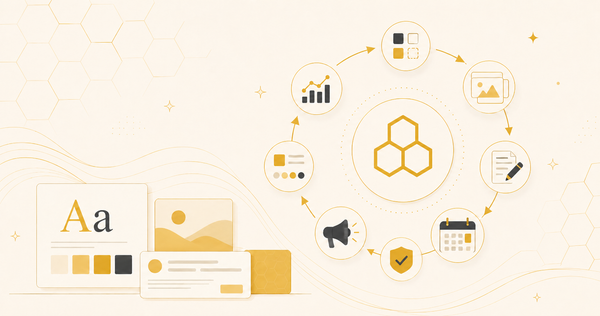
A complete brand strategy automation workflow has seven stages.
Step 1: Audit your current brand execution
Before automating, look at where inconsistency is already happening.
Check your website, social feeds, product pages, email campaigns, ads, and old graphics.
Ask whether the visuals feel like the same brand. Check whether the tone of voice changes depending on who wrote the content. Look at whether product benefits are explained clearly. Notice whether campaigns are planned or improvised. Check whether posts are formatted correctly for each platform. Ask whether content gets approved before publishing. Find the places where the team loses the most time.
This audit tells you what automation should fix first.
Step 2: Turn your brand strategy into usable inputs
A brand guide sitting in a folder is not automation.
The system needs to read and apply it.
At minimum, your brand input should include your color palette, typography, logo usage, tone of voice, visual references, words to use, words to avoid, audience description, content examples, competitor references, product positioning, offer language, and CTA style.
The more specific the brand input, the better the automated output.
Step 3: Create a product source of truth
For ecommerce brands and product-based businesses, your product catalog should become the content source of truth.
Each product should have a product name, short description, long description, features, benefits, use cases, images, dimensions, price or offer details, target customer, common objections, and best-selling angles.
Once this exists, every campaign can pull from accurate product data instead of relying on vague prompts.
Step 4: Build campaign rules
Campaigns need structure.
A good brand strategy automation system should let you define the campaign goal, product, audience, offer, deadline, platforms, number of posts, creative direction, caption direction, CTA, and publishing schedule.
This is where automation becomes strategic. The system is not just making content. It is making content inside a campaign framework.
Step 5: Generate the content
Once the brand, product, and campaign are defined, the system can generate the content.
That can include single-image posts, carousel posts, product placement visuals, promotional visuals, captions, hooks, hashtags, platform-specific variations, and campaign-wide content batches.
The best systems generate the visual, caption, and hashtag set together because those pieces should support the same idea.
A visual without the right caption feels incomplete. A caption without the right product context feels generic. A hashtag set without the right audience feels random.
Automation should connect the pieces.
Step 6: Review, edit, and approve
Human approval is not a weakness in the system.
It is what keeps the brand safe.
The system should produce drafts, not final public posts. You should be able to approve, edit, regenerate, delete, or reschedule anything before it goes live.
This keeps creative control with the brand while removing the production burden.
Step 7: Schedule and repeat
Once the content is approved, it should move into a calendar.
The calendar should handle timing, platform formatting, queue management, publishing status, and failed-post retries.
From there, the workflow becomes repeatable.
Import product. Set campaign. Generate content. Review drafts. Approve. Schedule. Publish. Measure. Repeat.
That is brand strategy automation.
What to automate and what to keep human
The best automation systems do not automate everything.
They automate the work that does not need your judgment.
Automate this
Automate product data extraction, brand guideline analysis, visual direction matching, caption drafts, hashtag research, carousel structure, platform formatting, content batching, scheduling, publishing after approval, status tracking, and routine content variations.
These tasks are repetitive, time-heavy, and easy to systematize.
Keep this human
Keep brand strategy, campaign priorities, final approval, sensitive messaging, community replies, crisis judgment, major creative direction shifts, customer conversations, and high-stakes offers human.
Automation should support human judgment, not replace it.
A founder should not spend three hours resizing social posts. A founder should decide what the brand needs to say next.
Brand strategy automation for small businesses
Small businesses need brand automation more than anyone because they usually have the least help.
A large company can have a brand manager, content strategist, designer, copywriter, social media manager, and paid media team.
A small brand often has one person doing all of it.
That creates a dangerous gap: the product may be good, but the brand presence does not reflect it.
Brand strategy automation helps close that gap.
It gives small businesses a way to create consistent social content without hiring a full creative team, launch campaigns faster, keep feeds active without daily manual posting, turn product pages into ready-to-publish content, maintain brand voice across channels, avoid generic AI output, reduce dependency on freelancers, and scale content without scaling headcount.
For a product-based business, this can be the difference between looking unfinished and looking like a serious brand.
Brand strategy automation for ecommerce and DTC brands
Ecommerce brands have a specific advantage with automation: their product pages already contain structured content.
A product URL can give the system the product name, images, descriptions, features, benefits, variants, materials, use cases, and customer-facing language.
That means the automation system does not have to start from a blank prompt. It starts from the actual product.
For DTC brands, this is powerful because social media is often the main storefront. Customers discover the brand on TikTok, Pinterest, Instagram, or Facebook before they ever visit the website.
If the social content looks generic, the product feels generic.
If the social content looks polished, specific, and consistent, the product feels more trustworthy.
Brand strategy automation helps ecommerce brands turn product information into marketing assets without rebuilding the content process manually for every SKU.
The core components of a brand strategy automation platform
A strong brand strategy automation platform should include six core components.
1. Brand intelligence
The system should learn the brand before generating anything.
This includes visual identity, voice, tone, references, colors, typography, and creative direction.
Without brand intelligence, automation becomes random production. With it, the system can create content that feels connected to the same brand every time.
2. Product intelligence
The system should understand what you sell.
Product URL import, product image extraction, feature extraction, benefit extraction, and product catalog management all matter here.
This is especially important for ecommerce brands, where every product has different angles, benefits, use cases, and visuals.
3. AI content generation
The system should create visuals, captions, hooks, hashtags, carousels, and campaign content that match the brand and product context.
Good AI content generation is not just about writing something that sounds nice. It is about producing content that fits the brand, the platform, the campaign, and the product.
4. Campaign workflow
The system should let you build campaigns around goals, products, offers, audiences, and deadlines.
A campaign workflow gives the content a purpose. It turns random posting into structured marketing.
5. Review and approval
The system should never treat generated content as automatically publishable.
Draft-first publishing protects the brand.
You should be able to review, approve, edit, regenerate, or delete content before it reaches your audience.
6. Scheduling and publishing
The system should place approved content into a calendar and publish it to the right platforms at the right time.
This is where brand strategy automation becomes an actual operating system, not just a content generator.
Together, these components create an end-to-end brand automation workflow.
Common brand strategy automation mistakes
Automation can make a good brand more consistent.
It can also make a weak brand’s problems louder.
Avoid these mistakes.
Mistake 1: Automating before defining the brand
If your tone, visuals, and positioning are unclear, automation will not fix them. It will multiply the confusion.
Start with the brand standard.
Mistake 2: Using generic AI tools for brand-specific work
A generic prompt tool can help with ideas, but it does not know your brand by default.
For brand strategy automation, the system needs brand memory.
Mistake 3: Removing human approval
Auto-publishing AI content without review is risky.
The best workflow is fast, but still controlled.
Mistake 4: Treating every platform the same
Cross-posting the exact same content everywhere is not strategy.
Your message can stay consistent while the format changes for each platform.
Mistake 5: Automating random posts instead of campaigns
One-off posts are useful, but campaigns build momentum.
Automate around campaigns, not isolated content.
Mistake 6: Forgetting product accuracy
For ecommerce brands, product details matter.
If the AI misunderstands the product, the content loses trust.
How to measure brand strategy automation ROI
Brand strategy automation should make your marketing system faster, more consistent, and easier to manage.
Track time saved per week, number of posts created, number of campaigns launched, approval time, publishing consistency, content quality, brand consistency, cost per asset, reduction in manual design work, reduction in freelancer dependency, platform engagement, traffic from social content, and conversion from product campaigns.
Do not only measure output volume.
More content is not automatically better.
The real question is whether your brand can show up more often without looking cheaper, less consistent, or less thoughtful.
Best brand strategy automation software: what to look for
The right software depends on what you need to automate.
If you only need scheduling, a social media scheduler may be enough.
If you need templates, a design tool with brand kits may be enough.
If you need brand asset storage, a digital asset management platform may be enough.
But if your real problem is producing on-brand content consistently, look for a platform that includes brand guideline import, website brand extraction, product URL import, AI-generated visuals, AI captions, AI hashtag generation, campaign generation, a social media calendar, draft approval, multi-platform publishing, brand voice control, visual reference matching, product-based content generation, AI editing, and human approval before publishing.
That is the difference between a tool that helps with one task and a system that runs the workflow.
BeeWritten: brand strategy automation for product-based businesses
BeeWritten is built for brands that care about how they show up but do not have time to coordinate a creative team for every post.
It is not just a caption generator.
It is a brand-aware creative operations platform for social media content.
BeeWritten reads your brand guide, learns your colors, tone, references, and visual identity, then applies that standard across your posts. You can import a product URL, and BeeWritten turns the product information into content-ready inputs: images, descriptions, features, benefits, and campaign angles.
From there, BeeWritten can generate social media visuals, captions, hashtags, and carousel structures for your campaigns.
The workflow stays controlled. Posts are drafts first. You can approve, edit, regenerate, or delete content before anything publishes.
Melibee, the in-app AI assistant, makes the workflow feel less like managing software and more like talking to a creative operator. You can ask for a campaign, adjust captions, schedule posts, or check what is coming next from the same conversation.
For small brands, this matters.
You do not need to brief a designer, write a caption, resize a post, research hashtags, schedule the content, and repeat it all again tomorrow.
You paste your product URL. You give the brand standard once. BeeWritten helps turn that into a social content system.
That is brand strategy automation in practice.
How BeeWritten turns brand strategy into content
A lot of tools help you create content faster.
BeeWritten is built to help you create content that still feels like your brand.
Here is how the workflow works.
1. Import your brand
BeeWritten can work from your brand guide, website, visual references, tone of voice, and brand identity.
Instead of asking you to re-explain your style every time, BeeWritten keeps your brand context inside the workflow.
2. Import your product
Paste a product URL and BeeWritten can turn the page into usable marketing context.
That means your product images, descriptions, features, benefits, and selling angles become part of the content generation process.
3. Create a campaign
Choose the campaign goal, product, audience, offer, platform, and schedule.
BeeWritten uses that direction to create content that has a reason to exist.
4. Generate posts
BeeWritten can generate visuals, captions, hashtags, and carousel ideas that match the campaign and brand identity.
This helps you move from product page to publish-ready social content without building every asset manually.
5. Review before publishing
Nothing needs to go live without your approval.
You can edit, approve, regenerate, or delete posts before they are scheduled or published.
That keeps the speed of automation without giving up creative control.
Example: brand strategy automation in a real product launch
Imagine you are launching a new skincare product.
Without automation, the workflow might look like this.
Write a product brief. Send it to a designer. Wait for visuals. Write captions. Edit captions. Resize assets for each platform. Create a carousel. Make Pinterest pins. Build TikTok variations. Find hashtags. Schedule posts. Double-check everything. Fix something at midnight because the product name was spelled differently in one asset.
With brand strategy automation, the workflow becomes much cleaner.
Import the product URL. Select the launch campaign goal. Choose the platforms. Set the offer and deadline. Generate campaign content. Review the drafts. Approve the best posts. Schedule the campaign.
The difference is not just speed.
It is consistency.
Every post comes from the same product information, the same brand identity, the same campaign objective, and the same approval workflow.
That is how small teams start operating with the polish of larger teams.
Brand strategy automation checklist
Before choosing a brand strategy automation tool, use this checklist.
Your system should help you define your brand voice, store your visual identity, import brand guidelines, use product data accurately, generate campaign-specific content, create platform-ready posts, produce visuals and captions together, build carousel content, create social media campaigns, schedule approved content, keep humans in the approval loop, avoid off-brand AI output, manage multiple products or campaigns, maintain consistency across platforms, and scale content without scaling headcount.
If a tool only helps with one of those things, it may still be useful.
But it is not a full brand strategy automation system.
Brand strategy automation keywords to understand
If you are researching this space, you will likely see several related terms.
Automated branding
Automated branding refers to using software to create or manage brand assets, templates, logos, visuals, and brand rules.
Brand management automation
Brand management automation focuses on governance: making sure assets, campaigns, teams, and approvals follow brand standards.
Brand consistency automation
Brand consistency automation helps ensure that content looks and sounds the same across platforms, campaigns, and teams.
AI brand strategy
AI brand strategy uses artificial intelligence to support brand positioning, messaging, content direction, and campaign development.
Creative automation
Creative automation focuses on producing creative assets at scale, often through templates, AI, or dynamic content systems.
Social media automation for brands
Social media automation for brands includes planning, generating, scheduling, and publishing content across social platforms while protecting brand identity.
Brand strategy automation connects all of these ideas into one workflow.
It brings together the brand, the product, the campaign, the content, the approval process, and the publishing calendar.
Final thoughts
Brand strategy automation is not about making marketing colder.
It is about making the standard easier to protect.
The best brands are not consistent by accident. They have systems. They know what they sound like. They know what they look like. They know what should never ship. They know how each campaign connects to the larger brand.
For a long time, only bigger teams could operate that way.
AI changes the cost of execution.
The brands that win will not be the ones publishing the most generic content. They will be the ones using automation to protect taste, speed up production, and show up consistently without losing the thing that made the brand worth following.
Your brand strategy should not live in a forgotten PDF.
It should run through every post, every campaign, every caption, every visual, and every launch.
That is what brand strategy automation makes possible.
And for product-based businesses, BeeWritten is built to make that workflow practical.
Paste your product URL. Let BeeWritten learn your brand. Review the drafts. Approve what feels right. Ship the content.
The creative thinking stays yours.
The production system finally catches up.
FAQ
What is brand strategy automation?
Brand strategy automation is the use of AI, workflows, brand guidelines, product data, approval systems, and scheduling tools to turn a brand strategy into repeatable marketing execution. It helps brands create consistent content without manually briefing every asset from scratch.
What is the difference between brand automation and brand strategy automation?
Brand automation usually focuses on automating brand assets, templates, approvals, or publishing workflows. Brand strategy automation goes deeper. It applies your positioning, tone of voice, visual identity, product context, campaign goals, and approval rules to the actual marketing content you create.
Can AI automate brand strategy?
AI can help execute and systematize brand strategy, but it should not replace human judgment. A good AI system can learn your guidelines, generate on-brand content, adapt posts for platforms, and create campaign drafts. Humans should still decide the positioning, offers, sensitive messaging, and final approval.
Is brand strategy automation useful for small businesses?
Yes. Small businesses often need brand strategy automation the most because they do not have large creative teams. Automation helps them create professional, consistent marketing content without hiring separate designers, copywriters, social media managers, and schedulers.
What can I automate in my brand strategy workflow?
You can automate product data extraction, brand guideline analysis, content generation, caption writing, hashtag creation, carousel planning, platform formatting, scheduling, publishing after approval, and post status tracking. You should keep campaign strategy, final approval, and customer conversations human.
What is brand consistency automation?
Brand consistency automation is the process of using software or AI to make sure your content follows the same visual identity, tone of voice, messaging style, and approval rules across every platform and campaign.
What is brand automation software?
Brand automation software helps teams create, manage, approve, and publish brand-consistent content with less manual work. Some tools focus on templates or asset management, while full brand strategy automation platforms connect brand identity, product data, campaign workflows, content generation, and publishing.
What is the best brand strategy automation software?
The best software depends on your workflow. For product-based businesses, look for a tool that can learn your brand, import product URLs, generate visuals and captions, create campaigns, support review and approval, and schedule posts across social platforms. BeeWritten is built specifically around that workflow.
How does BeeWritten help with brand strategy automation?
BeeWritten learns your brand identity, imports product information from URLs, generates on-brand visuals, captions, hashtags, and campaign content, then lets you review and approve posts before publishing. It helps product-based businesses turn brand strategy into a repeatable social content workflow.
How do I start with brand strategy automation?
Start by defining your brand identity, tone of voice, product information, campaign goals, approval rules, and publishing workflow. Then choose a system that can apply those inputs repeatedly. If you sell products, start with your product URLs and brand guidelines, then build campaigns from there.